

Leadership isn't defined by a title on a door—it shows up in the daily decisions, conversations, and habits that shape team culture and business results. Yet most organisations still rely on gut feeling or annual performance reviews to gauge whether their leaders are truly effective. This guide breaks down the most reliable, research-backed methods for measuring leadership behavior so you can move from guesswork to genuine insight.
Why Measuring Leadership Behavior Matters More Than Ever
Poor leadership costs organisations dearly. Disengaged employees, high turnover, and stagnant innovation are often traced back to leaders whose behaviors don't match organisational values. According to DDI research, 78% of HR leaders say behavior change is the most valuable way to measure leadership success—yet many still struggle to track it effectively.
Without a structured approach, even well-funded leadership programs become indefensible budget line items. When leadership development lacks measurable outcomes, it is often the first budget item cut during tough times. The organisations that thrive are the ones that connect leadership behavior directly to team engagement, retention, and strategic performance.
1. Use the Kirkpatrick Model as Your Measurement Framework
Before choosing individual tools, you need a framework. The Kirkpatrick Model remains the most widely used structure for evaluating leadership development impact. It evaluates learning across four progressive levels:
- Level 1 – Reaction: Did participants find the program engaging and relevant?
- Level 2 – Learning: Did they acquire new knowledge or skills?
- Level 3 – Behavior: Are they applying what they learned on the job?
- Level 4 – Results: Are targeted organisational outcomes occurring as a result?
Most organisations stop at Level 1 satisfaction surveys. The real value starts at Level 3—observable behavior change—and Level 4, where leadership growth links to business outcomes. Level 4 is the most comprehensive form of measurement and the level most likely to capture the attention of stakeholders and executives.
Practical Tip
Design your measurement plan before launching any leadership initiative. Decide which Kirkpatrick levels you will measure at the outset, set baseline data, and schedule checkpoints at 3, 6, and 12 months post-program.
2. Deploy 360-Degree Feedback Assessments
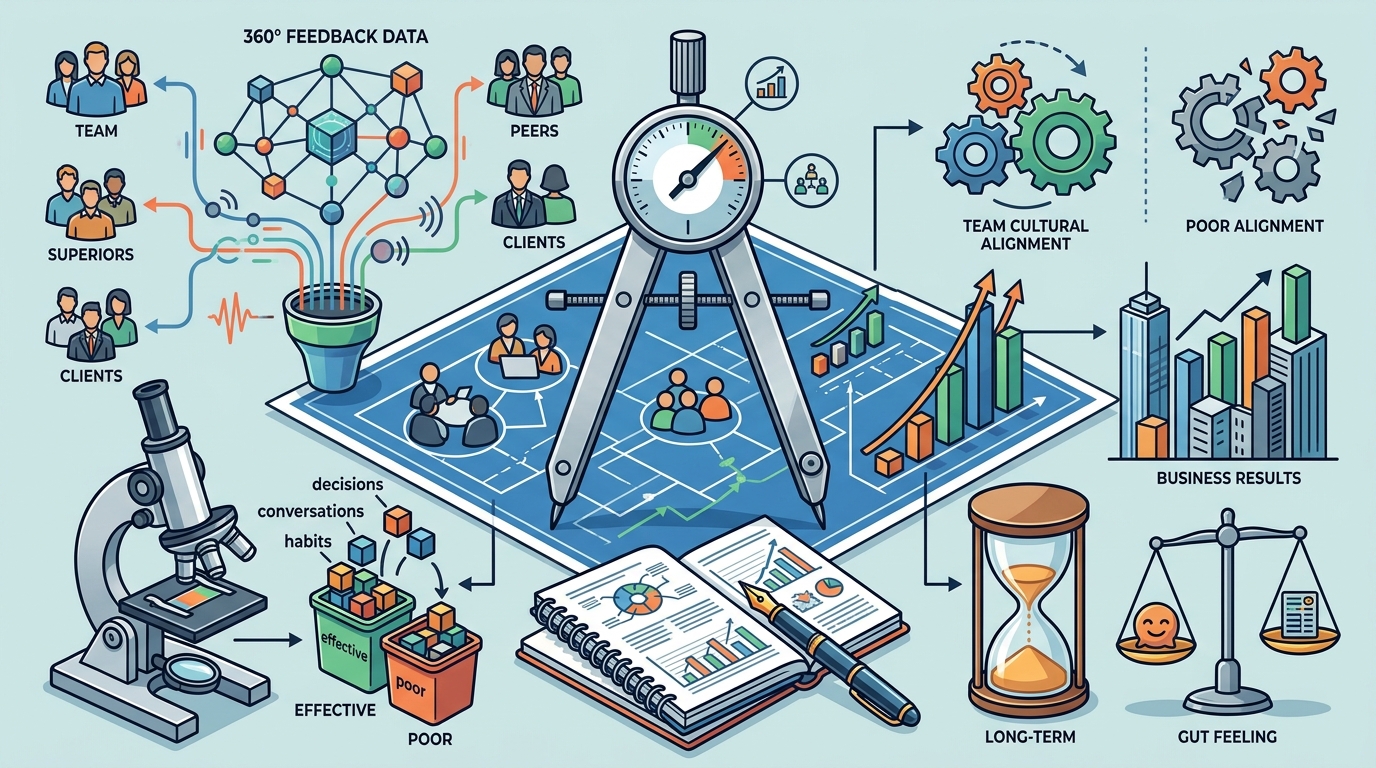
If there is one method that appears in virtually every evidence-based leadership development program, it is 360-degree feedback. This multi-rater approach gathers anonymous input from a leader's direct reports, peers, supervisors, and sometimes external partners to create a holistic picture of leadership behavior.
More than 85% of Fortune 500 companies use multi-rater feedback as a central part of their leadership development process. The method is popular because people are only about half as accurate in identifying their own strengths and weaknesses as their colleagues are. By leveraging multiple viewpoints, organisations ensure leaders receive a realistic appraisal rather than a one-dimensional review.
Key 360 Tools to Consider
- CCL Benchmarks® Suite: Supported by more than 50 years of research, offering pre-made assessments by leader level and a customisable option with over 90 competencies.
- Leadership Circle Profile (LCP): A 360-degree assessment that measures both creative leadership competencies and reactive tendencies, mapping the relationship between internal assumptions and external leadership behavior across 29 dimensions.
- Zenger Folkman Extraordinary Leader 360: Compares leaders against the 75th and 90th percentile of a global database containing over 1.5 million assessments, focusing on strengths-based development.
Making 360 Feedback Work
A 360 assessment is only as useful as the follow-up that accompanies it. One study tracking 281 managers found that combining 360-degree feedback with one-on-one coaching boosted leadership effectiveness by up to 60% according to follow-up colleague ratings. Best practice is to allow at least 18 months between 360 reviews so leaders have time to reflect, act, and demonstrate genuine behavior change.
3. Apply Validated Leadership Scales and Instruments
Validated psychometric instruments give you standardised, comparable data on specific leadership behaviors. Research from the Center for Creative Leadership indicates that organisations using validated leadership scales improve leadership development outcomes by 40% compared to those relying on subjective evaluation alone.
Three Proven Instruments
- Multifactor Leadership Questionnaire (MLQ): Developed by Bass and Avolio, the MLQ measures transformational, transactional, and passive/avoidant leadership styles. It is one of the most extensively validated instruments in leadership research and is ideal for understanding how leaders motivate and inspire teams.
- Leadership Practices Inventory (LPI): Created by Kouzes and Posner, the LPI measures 30 specific leadership behaviors mapped to Five Practices of Exemplary Leadership. Built on over 40 years of research and validated by independent studies, it provides actionable feedback for leaders at every level.
- Hogan Assessments: This suite measures routine personality characteristics (HPI), potential derailment behaviors under stress (HDS), and underlying motivational values (MVPI), giving a comprehensive view of leadership risk and potential.
No single instrument captures leadership completely. Combine multiple assessment methods and interpret results contextually using qualified professionals for the most accurate measurement.
4. Conduct Structured Behavioral Observation
Assessment centres and structured observation exercises put leaders into realistic scenarios—conflict resolution simulations, strategic planning exercises, team facilitation tasks—and trained observers rate specific behaviors against a rubric.
This method addresses a key limitation of self-report and survey tools: it captures what leaders actually do under pressure, not just what they or others say they do. Assessment centres are particularly valuable for selection decisions and high-potential identification because they assess how leaders behave in varying situations, creating patterns in communication, conflict resolution, and decision-making.
When to Use Behavioral Observation
- Promotion and succession planning decisions
- High-potential talent identification
- Evaluating whether leaders apply new skills from development programs
5. Track Team-Level Engagement and Retention Metrics
Leadership behavior doesn't exist in a vacuum—it shows up in the people a leader influences. Gallup research shows that managers account for at least 70% of the variance in team engagement, meaning a leader's behavior heavily determines whether employees feel motivated or plan to leave.
Key Downstream Metrics
- Employee engagement scores: Use pulse surveys to monitor changes under specific leaders over time.
- Turnover and retention rates: One analysis found that employees who received 360-degree feedback had 15.9% better retention rates than those who did not.
- Bench strength ratio: Count how many employees are ready to move up within one to two levels of current leadership roles. Target at least three qualified successors for each critical position.
- Team productivity and performance: Compare output, project success rates, and time-to-promotion under different leaders.
These metrics give you the 'so what' behind behavioral data. When a leader's 360 scores improve and their team's engagement rises in tandem, you have a powerful narrative linking behavior change to business impact.
6. Build an Internal Leadership Behavior Index
For organisations that want a tailored, ongoing measurement tool, a Leadership Behavior Index is a practical option. This approach uses a short, customised survey—typically 10 to 15 statements—completed by a leader's direct reports, measuring how consistently the leader demonstrates specific behaviors aligned to organisational values.
The concept mirrors FedEx's well-known Leadership Index, and the current Gallup Q12 engagement survey closely mirrors this design philosophy. Ideally, an organisation's mission, vision, and value statements serve as sources for its Leadership Index statements.
How It Works in Practice
- Define 10–15 behavioral statements drawn from your organisation's strategic priorities and values.
- Deploy the index as part of a regular employee attitude survey (quarterly or biannually).
- Set a minimum favorability threshold—leaders falling below it enter a structured improvement process.
- Each leader reviews results with their team and co-creates an action plan.
- Provide coaching support and re-measure at the next cycle.
This approach is especially useful for small-to-medium businesses, healthcare organisations, and education providers that need a simple yet rigorous measurement process.
7. Implement Pre- and Post-Program Assessments
The most direct way to determine whether a leadership program changed behavior is to measure the same competencies before and after the intervention. A comprehensive approach includes pre- and post-program assessments, manager evaluations, and longitudinal 360 feedback.
DDI's Impact Evaluation survey of more than 1,300 leaders found that after attending their development program, 82% of participants were rated as effective—a 24% increase from before the program. This kind of data gives L&D teams a clear ROI narrative.
Best Practice for Longitudinal Measurement
- Set measurement checkpoints at 3, 6, and 12 months after the formal program ends.
- Collect observations from managers, peers, and direct reports—not just self-reports.
- Track both behavioral frequency (how often a leader demonstrates a skill) and behavioral quality (how effectively they apply it).
Key Takeaways
- Start with a framework. The Kirkpatrick Model provides a structured path from reaction data to business outcomes.
- 360-degree feedback is non-negotiable. Multi-rater input is the gold standard for understanding how leaders are perceived and where blind spots exist.
- Use validated instruments. Tools like the MLQ, LPI, and Hogan Assessments give you standardised, research-backed data.
- Observe behavior directly. Assessment centres and structured simulations capture what leaders actually do under pressure.
- Connect behavior to business metrics. Track engagement scores, retention, bench strength, and productivity as downstream indicators of leadership quality.
- Build internal indices. A customised Leadership Behavior Index keeps measurement aligned to your unique values and strategy.
- Measure over time. Pre-post assessments with follow-up at 3, 6, and 12 months reveal whether change is sustained.
- Pair measurement with coaching. Feedback alone doesn't drive change—coaching accelerates the translation of insight into action.
Frequently Asked Questions
What is the best tool for measuring leadership behavior?
There is no single best tool. For transformational leadership research and development, the MLQ offers extensive validation. For practical leadership development with actionable feedback, the LPI is highly effective. For selection and risk assessment, Hogan Assessments predict leadership emergence and derailment. Most experts recommend combining multiple methods for a comprehensive picture.
How often should leadership behavior be measured?
For development tracking, annual assessment enables progress monitoring without creating assessment fatigue. For 360-degree feedback specifically, best practice is to allow at least 18 months between reviews. For program evaluation, pre- and post-assessments with follow-up checkpoints at 3, 6, and 12 months provide the most actionable data.
Can leadership behavior really be measured objectively?
Leadership can be measured with reasonable accuracy using validated instruments, though all measurement has limitations. Quality scales reliably assess specific leadership dimensions when properly administered and interpreted. Because leadership is multifaceted, no single measure captures it completely. Combining quantitative tools with qualitative observation yields the most realistic and holistic picture.
What is the Kirkpatrick Model in leadership development?
The Kirkpatrick Model evaluates leadership development across four levels: Reaction (participant satisfaction), Learning (knowledge gained), Behavior (on-the-job application), and Results (business outcomes). It is the most widely used framework for measuring training and development impact and helps organisations connect learning investments to tangible outcomes.
How does 360-degree feedback improve leadership?
360-degree feedback gathers anonymous input from direct reports, peers, and supervisors to reveal how a leader's behavior is experienced by others. It exposes blind spots that self-assessment alone cannot detect. When combined with coaching, research shows it can boost leadership effectiveness by up to 60%. The key is treating 360 feedback as a developmental tool with structured follow-up, not a one-time evaluation.