

Great leadership today is not defined by technical expertise alone. Emotional intelligence (EI) is the ability to recognise, understand, and manage your own emotions while influencing the emotions of others. Research consistently shows that leaders with high EI build stronger teams, resolve conflict faster, and drive measurable performance gains. In this guide, you will learn the five core components of emotional intelligence, practical strategies for applying each one, and how to embed EI into your daily leadership habits. Whether you lead a team of five or five hundred, these principles will help you create a culture where people thrive.
What Is Emotional Intelligence in Leadership?
Emotional intelligence is the capacity to understand and manage emotions, both your own and those of the people around you. In a leadership context, EI enables you to detect nuances in emotional reactions and use that knowledge to influence, motivate, and guide your team effectively.
According to a hybrid literature review published in Heliyon (2023), emotionally intelligent leaders improve both behaviours and business results and have a direct impact on work team performance. This is not a soft skill in the traditional sense. It is a strategic capability that powers better decisions and stronger relationships.
At Uncapped Potential, we have seen this first-hand across three decades of leadership advisory work. Emotional intelligence is the differentiator that separates competent managers from truly transformative leaders.
The Five Components of Emotional Intelligence
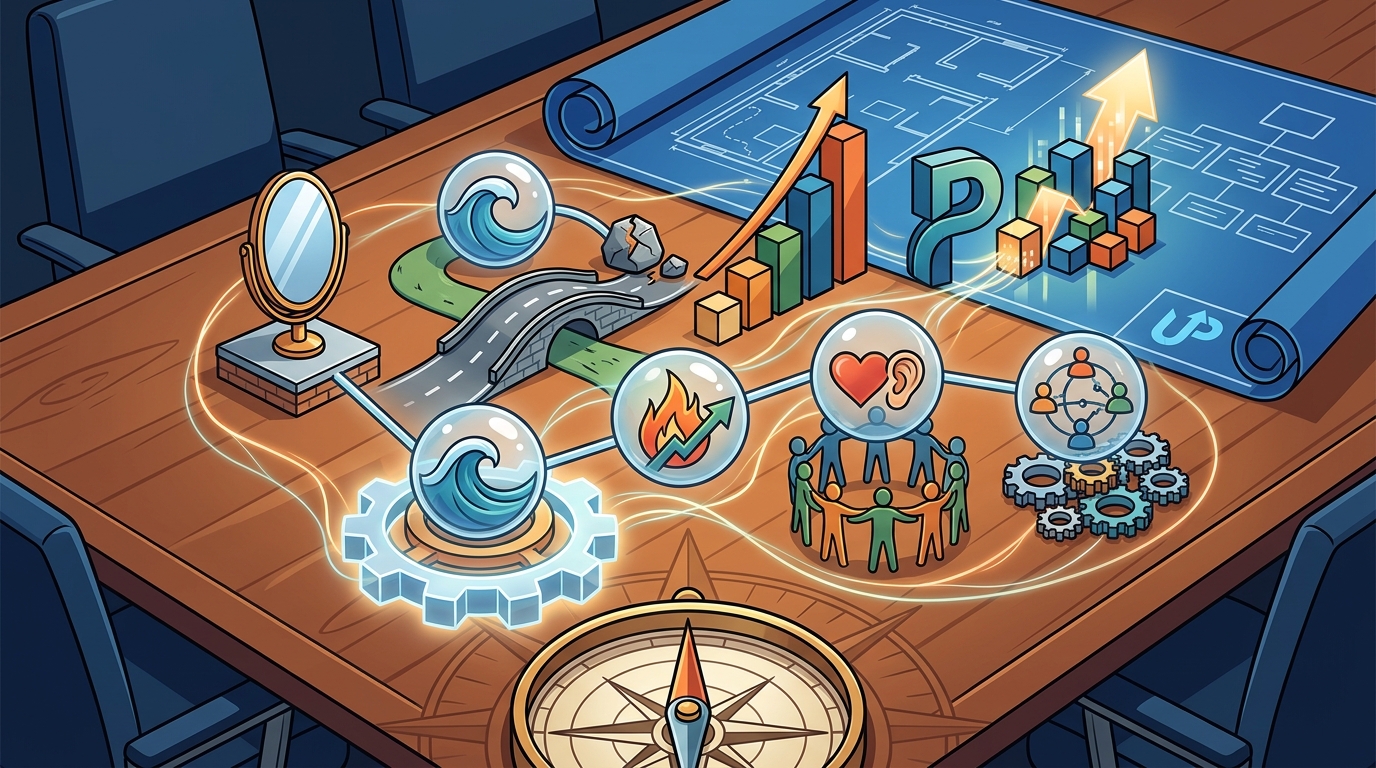
Psychologist Daniel Goleman popularised a framework that breaks EI into five components: self-awareness, self-regulation, motivation, empathy, and social skills. Each component plays a distinct role in leadership effectiveness.
Self-Awareness and Self-Regulation
Self-awareness is the ability to recognise your own moods, emotions, and drives and understand how they affect others. Self-regulation is the practice of controlling impulses and expressing emotions appropriately rather than reacting on instinct. Together, they form the internal foundation of emotionally intelligent leadership.
Motivation and Empathy
Motivation, in Goleman's model, refers to an inner drive to pursue goals for reasons beyond money or status. Empathy is the ability to understand and share the feelings of others, which is essential for building trust and psychological safety within teams.
Social Skills
Social skills encompass communication, conflict resolution, persuasion, and collaboration. Leaders with strong social skills create alignment, foster open dialogue, and move teams toward shared objectives with clarity. Learn more about how leadership development programs at Uncapped Potential hone these exact behaviours.
Why EI Matters More Than IQ for Leaders
While IQ remains a predictor of individual capability, it is insufficient for achieving long-term organisational success. A study published in Heliyon found that emotional competencies account for two out of three essential skills for effective performance across a wide range of job positions globally.
Separate research surveying 100 professionals found strong correlations between EI and key leadership traits such as empathy, ethical conduct, social competence, and motivational effectiveness. Leaders with higher levels of EI were perceived as more capable of fostering trust, resolving conflicts, and inspiring commitment.
The bottom line: technical skills get you into the leadership role, but emotional intelligence determines how far you go. As Uncapped Potential's keynote programs emphasise, EI is a strategic capability that powers better decisions and consistently higher team performance.
Practical Strategies to Lead With EI
1. Pause Before You React
Self-regulation starts with creating a gap between stimulus and response. Before responding to a difficult email, a team disagreement, or bad news, take a deliberate pause. This small habit prevents reactive decision-making and models emotional maturity for your team.
2. Ask More, Tell Less
Empathetic leaders ask open-ended questions and listen to understand, not to respond. Replace directive statements with curiosity. Instead of "Here is what we are doing," try "What do you think we should prioritise?" This builds psychological safety and uncovers insights you would otherwise miss.
3. Name the Emotion in the Room
When tension is high, acknowledging the emotional temperature signals self-awareness and creates permission for honest conversation. Saying "I can see this change is creating uncertainty" is far more effective than ignoring the discomfort. Our approach to purposeful conversations at Uncapped Potential focuses on building this exact courage and confidence.
Emotional Intelligence vs Traditional Leadership Skills
| Dimension | Traditional Leadership | EI-Driven Leadership |
|---|---|---|
| Decision-Making | Data and logic only | Data informed by emotional context |
| Conflict Resolution | Policy enforcement | Empathetic dialogue and understanding |
| Team Motivation | Targets and incentives | Purpose, trust, and intrinsic drivers |
| Communication Style | Top-down directives | Two-way, transparent conversation |
| Culture Impact | Compliance-focused | Engagement and psychological safety |
| Adaptability | Rigid frameworks | Flexible, situationally aware responses |
This comparison illustrates that emotionally intelligent leadership does not replace analytical rigour. Instead, it layers emotional context on top of logic, resulting in more resilient and adaptive teams.
Building an Emotionally Intelligent Team Culture
Individual EI is only part of the equation. For lasting impact, emotional intelligence must be embedded into team norms and organisational culture. Research confirms that EI-driven leadership fosters healthier workplace cultures, reducing stress and enhancing job satisfaction.
Start by modelling vulnerability. Share what you are learning and where you are growing. Encourage feedback loops where team members feel safe to challenge ideas. Invest in structured development that goes beyond one-off training.
At Uncapped Potential, our programs are built on the principle that leadership effectiveness is no longer about technical capability alone. We use tools such as Human Synergistics LSI to provide leaders with data-driven insight into their thinking and behavioural styles, creating a foundation for genuine transformation.
Key Takeaways
- Emotional intelligence is the ability to recognise, understand, and manage emotions in yourself and others.
- Daniel Goleman's five EI components are self-awareness, self-regulation, motivation, empathy, and social skills.
- Research shows emotional competencies account for two-thirds of the skills needed for effective job performance.
- Leaders with high EI are perceived as more empathetic, ethical, and effective at motivating teams.
- Practical EI habits include pausing before reacting, asking more questions, and naming emotions openly.
- EI must be embedded in team culture, not treated as a one-off training exercise.
- Tools like Human Synergistics LSI provide measurable behavioural insights to accelerate EI development.
Frequently Asked Questions
What is emotional intelligence in leadership?
Emotional intelligence in leadership is the ability to understand your own emotions and those of your team, then use that awareness to guide decisions, communication, and behaviour that drive performance and trust.
Can emotional intelligence be learned?
Yes. Daniel Goleman himself states that emotional intelligence can be learned and improved over time. Structured programs and consistent practice make the difference.
What are the five components of emotional intelligence?
The five components, as defined by Daniel Goleman, are self-awareness, self-regulation, motivation, empathy, and social skills. Each one contributes to how effectively a leader engages with their team.
How does emotional intelligence improve team performance?
EI improves team performance by enhancing trust, reducing conflict, increasing motivation, and fostering psychological safety. Teams led by emotionally intelligent leaders collaborate more effectively and adapt faster to change.
What is the difference between EQ and IQ in leadership?
IQ measures cognitive ability, while EQ (emotional quotient) measures emotional and social competence. In leadership, EQ is often the stronger predictor of success because it governs relationships, influence, and culture.
How can I measure my emotional intelligence?
Tools such as the Human Synergistics Life Styles Inventory (LSI) and the Emotional and Social Competency Inventory (ESCI) provide validated assessments. Working with a certified facilitator ensures accurate interpretation and actionable development plans.
Why do some leadership training programs fail?
Many programs focus on theory without addressing the underlying thinking styles and behaviours that drive leadership effectiveness. Sustainable change requires personalised, emotionally intelligent approaches grounded in real-world experience.
How long does it take to develop emotional intelligence?
There is no fixed timeline. However, leaders who commit to regular self-reflection, feedback, and structured coaching typically see meaningful shifts in behaviour within three to six months.
Your Next Step
If you are ready to lead with greater emotional intelligence and create a high-performing team culture, start with a conversation. Book a consultation with Uncapped Potential to explore tailored leadership development solutions built on decades of real-world experience and certified emotional intelligence expertise.