

Effective leadership today demands far more than technical expertise or strategic thinking. Emotionally intelligent leadership is the capacity to recognise, understand, and manage your own emotions while skillfully influencing the emotions of others. Research consistently shows that leaders with high emotional intelligence (EI) drive stronger team engagement, lower turnover, and better business outcomes. According to Gallup's 2025 State of the Global Workplace report, 70% of team engagement is attributable to the manager. This guide breaks down the key elements every leader needs to master.
What Is Emotional Intelligence in Leadership?
Emotional intelligence is the ability to recognise, understand, and manage our own emotions, as well as the ability to recognise, understand, and influence the emotions of others. The concept was popularised by psychologist Daniel Goleman in his 1995 book Emotional Intelligence, and it has since become a cornerstone of modern leadership development.
In leadership contexts, EI goes beyond personal awareness. It shapes how leaders build trust, navigate conflict, and inspire performance across teams. Organisations like Uncapped Potential have spent over 30 years harnessing the power of emotional intelligence to sculpt high-performing cultures built on trust, authenticity, and purpose.
The Five Core Elements of Emotionally Intelligent Leadership
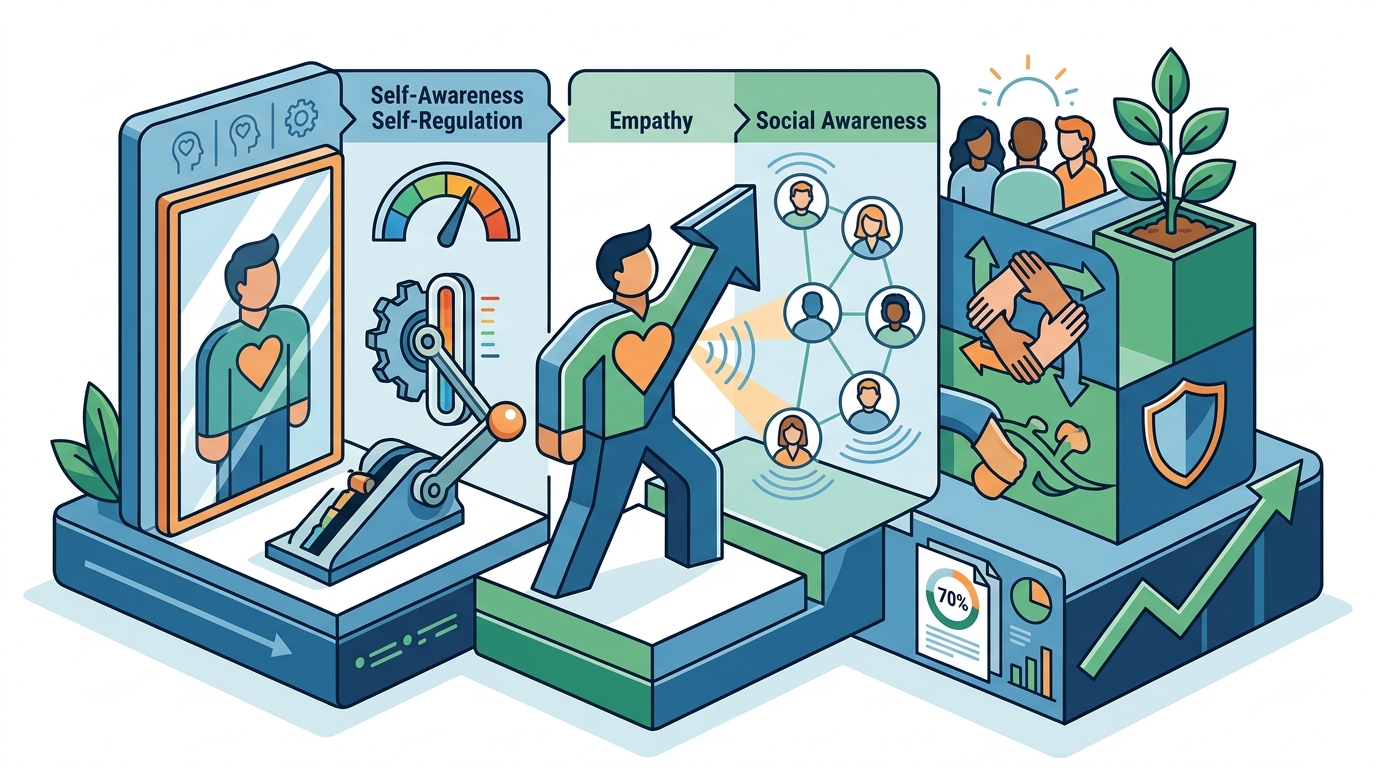
Goleman's original framework identifies five elements that together form the foundation of emotionally intelligent leadership. Here is how each one applies in practice.
1. Self-Awareness
Self-awareness is the ability to recognise your own emotions, strengths, weaknesses, and their impact on others. It is the foundation upon which every other EI competency is built. Organisational psychologist Tasha Eurich found that only 10-15% of people are truly self-aware, despite 95% believing they are. Leaders who invest in building self-awareness gain a clearer picture of how their behaviour shapes team culture.
2. Self-Regulation
Self-regulation is the ability to control impulses and express emotions appropriately, especially under pressure. Leaders who self-regulate stay calm, avoid rash decisions, and model composure for their teams. This competency is critical when navigating organisational change or high-stakes negotiations.
3. Motivation
Intrinsic motivation is the inner drive to pursue goals for reasons beyond money or status. Emotionally intelligent leaders are energised by purpose, resilience, and a commitment to continuous improvement. They channel this drive into disciplined strategy and performance execution.
4. Empathy
Empathy is the ability to understand and share the feelings of others. A 2023 EY Empathy in Business Survey of over 1,000 US workers found that mutual empathy between leaders and employees leads to increased efficiency (88%), creativity (87%), and job satisfaction (87%). Leaders must be careful, however, to balance empathy with boundaries, as explored in the concept of the empathy trap.
5. Social Skills
Social skills encompass communication, conflict resolution, collaboration, and the ability to influence others. Leaders with strong social skills build cohesive teams, manage stakeholder relationships, and create environments where people thrive. These competencies are at the heart of effective leadership development programs.
Why Emotional Intelligence Matters More Than Ever
The modern workplace is defined by hybrid teams, rapid change, and increasing complexity. In this environment, emotionally intelligent leaders outperform their peers. Research published in the National Library of Medicine confirms that emotionally intelligent leaders improve both behaviours and business results and have a direct impact on work team performance.
The O.C. Tanner 2025 Global Culture Report found that organisations becoming emotionally smarter across every level are outperforming their peers significantly. EI is no longer just an executive trait; it is a general expectation for all employees.
EI vs IQ: What the Research Says
Technical intelligence gets you hired, but emotional intelligence gets you promoted and makes you an effective leader. The table below summarises the key differences.
| Dimension | IQ (Cognitive Intelligence) | EI (Emotional Intelligence) |
|---|---|---|
| Focus | Analytical reasoning, logic | Emotional awareness, relationships |
| Developability | Relatively fixed after early adulthood | Can be learned and improved at any age |
| Leadership impact | Problem-solving, technical decisions | Team engagement, culture, trust |
| Measurement | Standardised IQ tests | 360-degree assessments, LSI, TEIQue |
| Predictor of success | Threshold competency | Top differentiator at senior levels |
Goleman himself has argued that EI accounts for nearly 90% of what distinguishes outstanding leaders from average ones at senior levels. While IQ matters for baseline competence, EI is the multiplier that separates good leaders from great ones.
How to Measure Emotional Intelligence in Leaders
Measurement is essential because you cannot improve what you cannot see. Several validated tools exist for assessing EI in leadership contexts.
The Human Synergistics Life Styles Inventory (LSI) is one such tool. It allows leaders to visualise the thinking and behavioural styles that drive their performance. As accredited facilitators of Human Synergistics culture and leadership measurement tools, Uncapped Potential incorporates the LSI, Leadership/Impact, Group Styles Inventory, and Organisational Culture Inventory for powerful insight and change.
Other widely used instruments include Goleman and Boyatzis's Emotional and Social Competency Inventory (ESCI) and the Trait Emotional Intelligence Questionnaire (TEIQue). The best approach combines self-assessment with 360-degree feedback from peers, direct reports, and supervisors.
Developing Emotional Intelligence as a Leader
The good news is that emotional intelligence can be learned and improved. Goleman and Boyatzis describe EI competencies as the learned and learnable capabilities that allow outstanding performance as a leader. Here are practical steps to build each element.
Build a Practice of Reflection
Regular self-reflection through journaling, mindfulness, or coaching helps leaders tune into emotional patterns. Seek honest feedback from trusted colleagues. Consider why typical leadership training often falls short and what makes contextualised development different.
Invest in Contextualised Programs
Generic, off-the-shelf training rarely sticks. Effective EI development is tailored to the leader's context, industry, and organisational culture. Uncapped Potential creates masterclasses and programs that are contextualised to each business and harness the power of emotional intelligence.
Apply EI to Real Challenges
Practise empathy during difficult conversations. Regulate your response before reacting to conflict. Use social skills to build coalitions around strategic priorities. EI only develops through deliberate, repeated application in real-world situations.
Key Takeaways
- Emotional intelligence in leadership comprises five core elements: self-awareness, self-regulation, motivation, empathy, and social skills.
- EI is the top differentiator between good and outstanding leaders at senior levels.
- Gallup's 2025 data shows that 70% of team engagement depends on the manager.
- Empathy drives measurable gains in efficiency, creativity, and job satisfaction.
- EI can be measured using validated tools such as the Human Synergistics LSI and 360-degree assessments.
- Unlike IQ, emotional intelligence can be developed and improved at any stage of a leader's career.
- Contextualised, experiential development programs produce stronger results than generic training.
Frequently Asked Questions
What is emotionally intelligent leadership?
Emotionally intelligent leadership is the practice of leading others by recognising, understanding, and managing emotions in yourself and those around you. It draws on Daniel Goleman's framework of five core competencies: self-awareness, self-regulation, motivation, empathy, and social skills.
Why is emotional intelligence important for leaders?
Leaders with high EI build stronger teams, reduce turnover, and drive better business outcomes. Research shows emotionally intelligent leaders improve both behaviours and business results, and they are more effective at managing change and conflict.
Can emotional intelligence be learned?
Yes. Unlike cognitive intelligence, emotional intelligence can be developed through coaching, reflection, feedback, and contextualised training programs. Goleman describes EI competencies as learned and learnable capabilities.
What are the five elements of emotional intelligence?
The five elements are self-awareness, self-regulation, motivation, empathy, and social skills. Together, they form the foundation of effective interpersonal leadership and high-performing team cultures.
How do you measure emotional intelligence in the workplace?
Common tools include the Human Synergistics Life Styles Inventory (LSI), the Emotional and Social Competency Inventory (ESCI), and 360-degree feedback assessments. These provide data-driven insights into a leader's thinking and behavioural patterns.
What is the difference between EI and EQ?
EI (emotional intelligence) refers to the concept or ability itself. EQ (emotional quotient) is the measure or score used to quantify a person's level of emotional intelligence, similar to how IQ measures cognitive intelligence.
How does emotional intelligence affect team performance?
Emotionally intelligent leaders foster trust, psychological safety, and collaboration. Studies confirm a positive relationship between emotional competence and team members' attitudes, engagement, and productivity.
What role does empathy play in leadership?
Empathy allows leaders to understand their team members' perspectives and respond supportively. It increases employee satisfaction and creativity while reducing burnout. However, leaders must maintain healthy boundaries to avoid the empathy trap.
Take the Next Step
If you are ready to develop emotionally intelligent leadership capability in your organisation, the first step is understanding where you stand today. Book a consultation with Uncapped Potential to explore tailored leadership development solutions built on decades of real-world experience and the power of emotional intelligence.