

Emotionally intelligent leadership is the ability to recognise, understand, and manage your own emotions while also reading and influencing the emotions of others in a leadership context. Research consistently shows that emotional intelligence accounts for up to 58% of job performance across all role types, and 90% of top performers demonstrate high emotional intelligence. For organisations seeking sustainable growth, mastering these elements is not optional. It is foundational. This guide breaks down the core elements, explains why each matters, and shows how leaders can develop them to drive real performance outcomes.
What Is Emotional Intelligence in Leadership?
Emotional intelligence (EI) is the capacity to detect nuances in emotional reactions and use that knowledge to influence others by controlling and regulating emotions. In leadership, it goes beyond technical skill. It shapes how leaders build trust, resolve conflict, and create environments where people thrive.
Daniel Goleman, the American psychologist who popularised the concept through his 1995 bestseller, outlined a framework that leaders worldwide still use today. His model identifies five core components: self-awareness, self-regulation, motivation, empathy, and social skills. These are learned capabilities, not inborn traits, which means any leader can develop them over time.
The Five Core Elements of Emotionally Intelligent Leadership
1. Self-Awareness
Self-awareness is the ability to recognise your own emotions, strengths, and weaknesses, and understand their impact on your performance and relationships. It is the foundation upon which every other element rests. According to research by organisational psychologist Tasha Eurich cited by Harvard Business School, 95% of people think they are self-aware, but only 10 to 15% actually are.
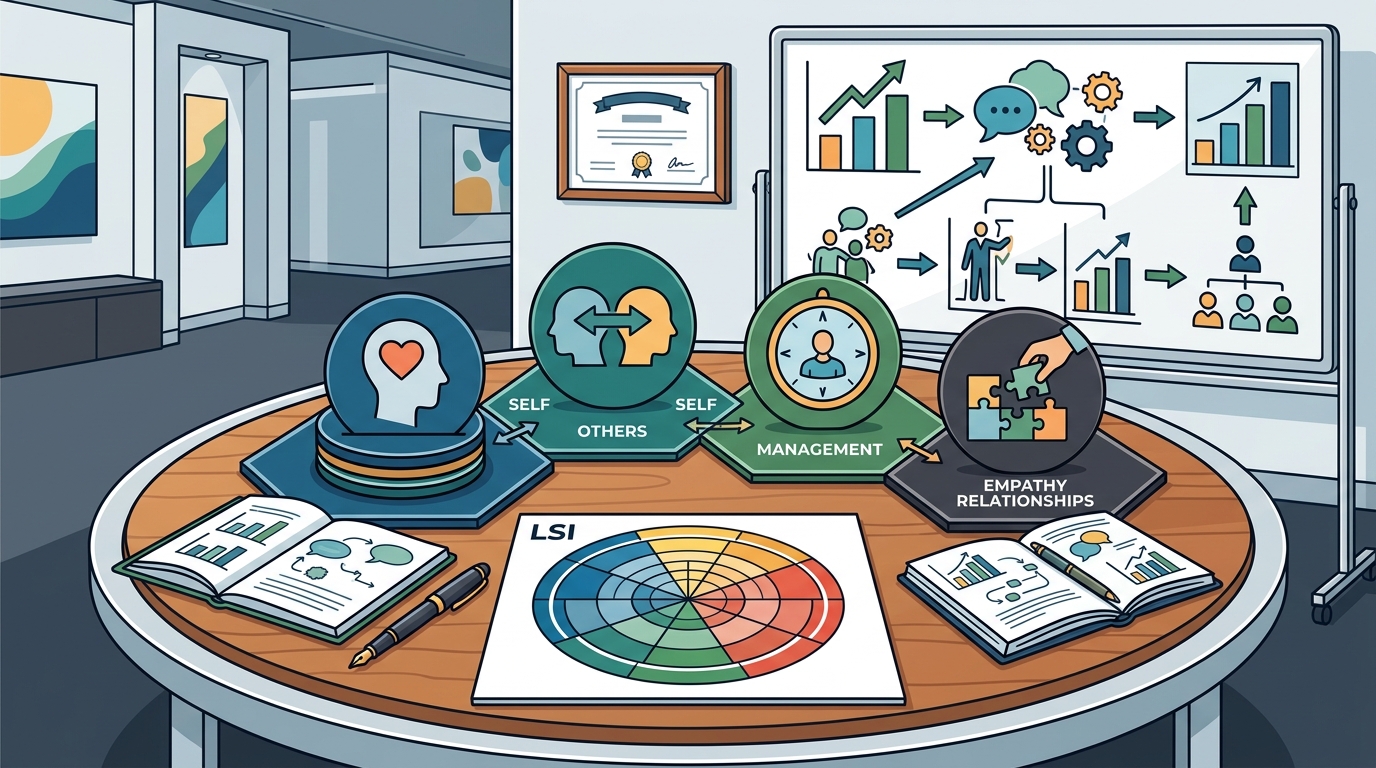
Leaders who invest in genuine self-awareness make sounder decisions and communicate more authentically. Tools like the Human Synergistics LSI help leaders measure their thinking and behaviour styles, providing a data-driven starting point for growth.
2. Self-Regulation
Self-regulation is the ability to manage your emotional impulses and respond intentionally rather than reactively. Leaders with strong self-regulation stay composed under pressure, maintain consistency in their behaviour, and model appropriate responses for their teams.
This element is critical because the emotional state of a leader is contagious. Research from the Yale School of Management confirms that emotions spread most powerfully from the leader outward. A leader who cannot regulate their own state will struggle to create a stable, productive team environment.
3. Motivation
Motivation, in Goleman's framework, refers to the emotional tendencies that guide or facilitate goal achievement beyond money and status. Emotionally intelligent leaders are driven by purpose, optimism, and a commitment to continuous improvement.
This intrinsic drive translates directly into strategy and performance outcomes. Leaders who model sustained motivation set the tone for disciplined execution and inspire their teams to push through setbacks with resilience.
How the Elements Compare: Goleman's Framework at a Glance
| Element | Domain | Focus | Leadership Application |
|---|---|---|---|
| Self-Awareness | Personal | Recognising emotions and impact | Better decision-making, authentic communication |
| Self-Regulation | Personal | Managing impulses and responses | Composure under pressure, consistent behaviour |
| Motivation | Personal | Purpose-driven achievement | Resilience, disciplined execution |
| Empathy | Social | Understanding others' emotions | Stronger relationships, reduced turnover |
| Social Skills | Social | Managing relationships effectively | Influence, conflict resolution, team cohesion |
The first three elements are personal competencies focused inward. Empathy and social skills are social competencies focused outward. Together, they form a complete system for emotionally intelligent leadership.
Why Emotional Intelligence Matters More Than IQ
The data makes a compelling case. According to research compiled by TalentSmart and SHRM, 85% of employers say EQ is more important than IQ for leadership roles, and teams with high-EQ leaders report 50% lower turnover rates.
Organisations with emotionally intelligent leadership also navigate change more effectively. McKinsey research found a 31% higher success rate in transformation initiatives when leaders demonstrate strong EI. Training in emotional intelligence delivers an average ROI of 5:1 on investment.
This is why typical leadership training often falls short. Programmes that ignore the emotional dimension of leadership miss the single biggest driver of performance.
How to Develop Emotional Intelligence as a Leader
Use Validated Assessment Tools
Start with measurement. Behavioural profiling tools like the Human Synergistics Life Styles Inventory (LSI) give leaders an objective view of their thinking styles and how those styles affect the people around them. Without a baseline, development is guesswork.
Invest in Ongoing Practice, Not One-Off Workshops
Unlike IQ, emotional intelligence can be developed. Research shows that targeted EQ training improves leadership capabilities by 25% or more. The key is sustained practice over time, not a single workshop. Emotional intelligence masterclasses that embed learning into real leadership contexts produce far better results than templated training.
Seek Honest Feedback
Leaders with the highest EI actively pursue candid feedback from peers, direct reports, and mentors. This creates a virtuous cycle: feedback sharpens self-awareness, which in turn strengthens every other EI competency.
Connecting EI to Culture and Organisational Performance
Emotionally intelligent leadership does not exist in isolation. It shapes culture. Leaders who demonstrate empathy, self-regulation, and social skill create psychological safety, which is the foundation of trust and confidence in high-performing teams.
Conversely, leaders with low emotional intelligence drain organisations over time. Employees under such leaders feel burnt out, disengaged, and eager to leave. The resulting turnover, absenteeism, and lost productivity represent a significant hidden cost that rarely shows up in traditional performance metrics.
This is why leadership development programmes must treat emotional intelligence as a core capability, not a soft skill bolted on at the end.
Key Takeaways
- Emotional intelligence is a set of learned capabilities, not fixed traits. Any leader can develop them.
- Goleman's five elements are self-awareness, self-regulation, motivation, empathy, and social skills.
- Self-awareness is the foundation. Without it, the other four elements cannot function effectively.
- EI accounts for up to 58% of job performance and is the strongest predictor of leadership effectiveness.
- Teams led by emotionally intelligent leaders experience up to 50% lower turnover.
- Validated tools like the Human Synergistics LSI provide measurable starting points for development.
- Sustained practice and honest feedback matter far more than one-off training events.
Frequently Asked Questions
What is emotionally intelligent leadership?
Emotionally intelligent leadership is the practice of leading by understanding and managing your own emotions while recognising and responding effectively to the emotions of others. It combines self-awareness, self-regulation, motivation, empathy, and social skills to create better outcomes for teams and organisations.
What are the five elements of emotional intelligence according to Goleman?
Daniel Goleman's five elements are self-awareness, self-regulation, motivation, empathy, and social skills. These five domains represent learned capabilities that can be developed over time through deliberate practice and feedback.
Can emotional intelligence be learned?
Yes. Unlike IQ, emotional intelligence can be developed through targeted training. Research indicates that focused EQ training can improve leadership capabilities by 25% or more.
Why is self-awareness the most important element?
Self-awareness is the foundation of all other EI competencies. You cannot regulate emotions you do not recognise, empathise effectively without understanding your own biases, or build social skills without knowing how your behaviour affects others.
How does emotional intelligence affect team performance?
Leaders with high EI foster trust, reduce conflict, and create psychological safety. This leads to higher engagement, lower absenteeism, and stronger collaboration, all of which directly improve team performance and retention.
What tools can measure emotional intelligence in leaders?
Validated instruments such as the Human Synergistics Life Styles Inventory (LSI) measure thinking and behaviour styles that underpin emotional intelligence. These tools provide objective data to guide targeted development.
How is emotional intelligence different from empathy?
Empathy is one component of emotional intelligence. EI also includes self-awareness, self-regulation, motivation, and social skills. Empathy alone, without the ability to regulate your own emotions, can actually become counterproductive in leadership contexts.
What is the ROI of emotional intelligence training?
Research suggests emotional intelligence training delivers an average return of 5:1 on investment. Organisations also see measurable improvements in employee engagement, retention, and leadership effectiveness.
Take the Next Step
Understanding the elements of emotionally intelligent leadership is just the beginning. If you are ready to measure and develop these capabilities in yourself or your leadership team, book a consultation with Uncapped Potential to explore how emotional intelligence can accelerate your organisation's performance.