

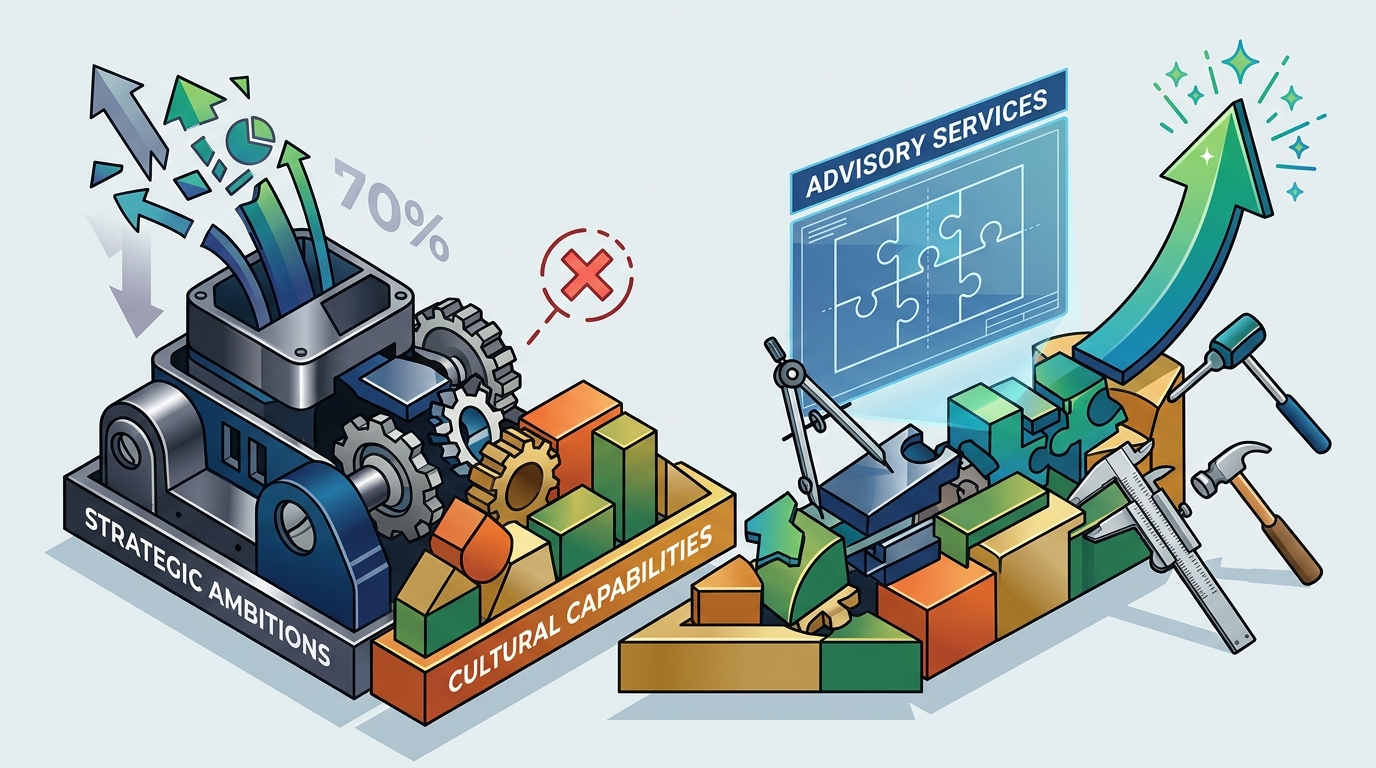
Organizations that fail to align their cultural capabilities with their strategic ambitions often stagnate, regardless of market conditions. Recent industry analysis indicates that over 70% of strategic transformations fail to meet their initial objectives due to a lack of human-centric execution frameworks. This statistic highlights a critical gap in modern business operations where technical solutions are prioritized over the psychological and behavioral drivers of performance. To bridge this divide, companies must look beyond traditional consulting models and adopt advisory services that integrate emotional intelligence with rigorous operational strategy. By leveraging specialized advisory support, leaders can transform complex organizational challenges into scalable opportunities for sustainable growth. (Extensive Real World Experience)
Strategic Advisory: Aligning Culture with Execution
Strategic advisory services focus on the intersection of high-level business goals and the day-to-day operational reality. Most organizations operate well within their limits, unaware of the untapped potential that exists when cultural barriers are removed. Advisory firms specialize in diagnosing these hidden inefficiencies and redesigning workflows to support ambitious targets. This approach moves beyond simple problem-solving to create a culture where capability is the primary engine of performance. (Leadership Emotional Intelligence Uncapped)
Effective strategic advisory requires a deep understanding of organizational dynamics. It involves assessing how decision-making processes are influenced by unconscious biases and interpersonal friction. By addressing these factors, advisors help leaders turn complexity into opportunity. This process ensures that strategic intent is not lost in translation during the execution phase. The result is a more agile organization that can respond to market shifts with precision and confidence.
One core component of this service is the implementation of purposeful conversation frameworks. These frameworks replace vague performance reviews with structured, high-impact dialogues. This shift allows leaders to address issues constructively and honestly. It fosters an environment where feedback is viewed as a tool for growth rather than a punitive measure. Consequently, teams become more aligned and motivated to achieve shared objectives.
Leadership Development: Building Emotional Resilience
Emotional intelligence is not a soft skill. It is the single most under leveraged competitive advantage available to any organization. Leaders who possess high emotional intelligence can navigate ambiguity with greater clarity and inspire their teams to perform at higher levels. Advisory services in this domain focus on developing these specific competencies through rigorous assessment and targeted coaching.
Leadership development programs often utilize advanced psychometric tools to provide deep insights into individual and collective behaviors. These tools help leaders understand their impact on others and identify areas for improvement. For instance, understanding one's own triggers and reactions allows for more deliberate and effective responses in high-pressure situations. This self-awareness is critical for maintaining stability during periods of rapid change or crisis.
Furthermore, these programs emphasize the inseparability of commercial success and people-centric leadership. Historically, these two concepts were viewed as competing priorities. Modern advisory frameworks demonstrate that they are actually mutually reinforcing. Leaders who prioritize authentic relationships and trust build stronger, more resilient teams. These teams are better equipped to drive innovation and deliver consistent results. The data shows that organizations with emotionally intelligent leaders experience significantly higher employee engagement and retention rates.
HR Mastery: Engineering Enterprise Performance
Human Resources has evolved from an administrative function to a strategic partner in enterprise performance. HR mastery services guide practitioners to drive strategy through people-centric initiatives. This involves redesigning talent acquisition, development, and retention strategies to align with broader business goals. Advisors help HR leaders become architects of culture rather than just managers of policy.
A key aspect of HR mastery is the integration of data-driven insights into people decisions. By analyzing workforce metrics, organizations can identify patterns in turnover, engagement, and productivity. This data allows for proactive interventions rather than reactive fixes. For example, identifying early warning signs of burnout can lead to targeted wellness initiatives that preserve talent and maintain productivity levels.
Advisory support in this area also includes the implementation of robust performance management systems. These systems ensure that individual contributions are clearly linked to organizational outcomes. They provide a framework for continuous feedback and development. This clarity helps employees understand how their work impacts the bottom line. It also creates a transparent path for career progression, which is a major driver of employee satisfaction and loyalty.
Comparing Advisory Service Models
Understanding the differences between various advisory approaches is essential for selecting the right partner. The table below outlines the core focus and typical outcomes of the primary service categories offered by specialized firms.
| Service Category | Primary Focus | Key Outcome | Target Audience |
|---|---|---|---|
| Strategic Advisory | Culture and Capability Alignment | Enhanced Execution Efficiency | C-Suite and Board Members |
| Leadership Development | Emotional Intelligence and Resilience | Improved Decision-Making | Senior and Emerging Leaders |
| HR Mastery | People Strategy and Systems | Optimized Talent Lifecycle | HR Directors and Practitioners |
| Conference Speaking | Thought Leadership and Inspiration | Shift in Organizational Mindset | Large Groups and Conferences |
Key Takeaways for Growth
- Emotional intelligence is a critical competitive advantage that AI cannot replicate, making it essential for future-proofing leadership teams.
- Organizations with aligned culture and strategy see a significant reduction in transformation failure rates, often exceeding 70% success in execution.
- Advisory services that focus on purposeful conversations can dramatically improve the quality of performance management and feedback loops.
- HR mastery involves moving beyond administrative tasks to become a strategic driver of enterprise performance through data-informed people practices.
- Leadership development programs utilizing psychometric insights help leaders understand their behavioral impact and improve interpersonal effectiveness.
- Strategic advisory firms often have decades of experience, with some practitioners having over 30 years in sculpting high-performing cultures.
- Investing in human potential yields a high return on investment through increased employee engagement, retention, and overall organizational agility.
Frequently Asked Questions
What is the difference between traditional consulting and advisory services?
Traditional consulting often provides specific solutions to immediate problems, whereas advisory services focus on building long-term internal capabilities and cultural alignment. Advisory partners work alongside leaders to ensure sustainable change and execution.
How does emotional intelligence impact organizational growth?
Emotional intelligence enables leaders to navigate complexity, build trust, and foster collaboration. This leads to better decision-making, higher employee engagement, and a more resilient organization capable of adapting to market changes.
What is Human Synergistics LSI®?
Human Synergistics LSI® is a comprehensive organizational assessment tool that measures culture and leadership styles. It provides data-driven insights into how organizational dynamics influence performance and effectiveness.
Can advisory services help with remote or hybrid team performance?
Yes, advisory services can design frameworks for purposeful communication and trust-building that are effective in remote environments. These frameworks ensure that cultural cohesion is maintained regardless of physical location.
What is Coach. purposeful conversations©?
Coach. purposeful conversations© is a proprietary framework designed to facilitate high-impact, constructive dialogues between leaders and their teams. It replaces vague feedback with structured, actionable conversations.
How long does it take to see results from advisory engagement?
While timelines vary, organizations typically begin to see shifts in cultural metrics and leadership behaviors within the first few months. Sustainable performance improvements often become evident within six to twelve months of consistent engagement.
Who are the typical clients of specialized advisory firms?
Typical clients include ambitious leaders, HR practitioners, and boards of directors who are seeking to close the gap between their strategic intent and their operational impact. These organizations are often in phases of growth, transformation, or cultural reset.
Next Steps for Your Organization
Accelerating growth requires more than just strategic planning; it demands a fundamental shift in how leadership and culture interact. By engaging with specialized advisory services, your organization can unlock the hidden potential within your teams and drive sustainable performance. We work with ambitious leaders to close the gap between intent and impact. If you are ready to transform your organizational culture and drive peak performance, contact us today to schedule a consultation. Let us help you discover what happens when you operate beyond your limits.