

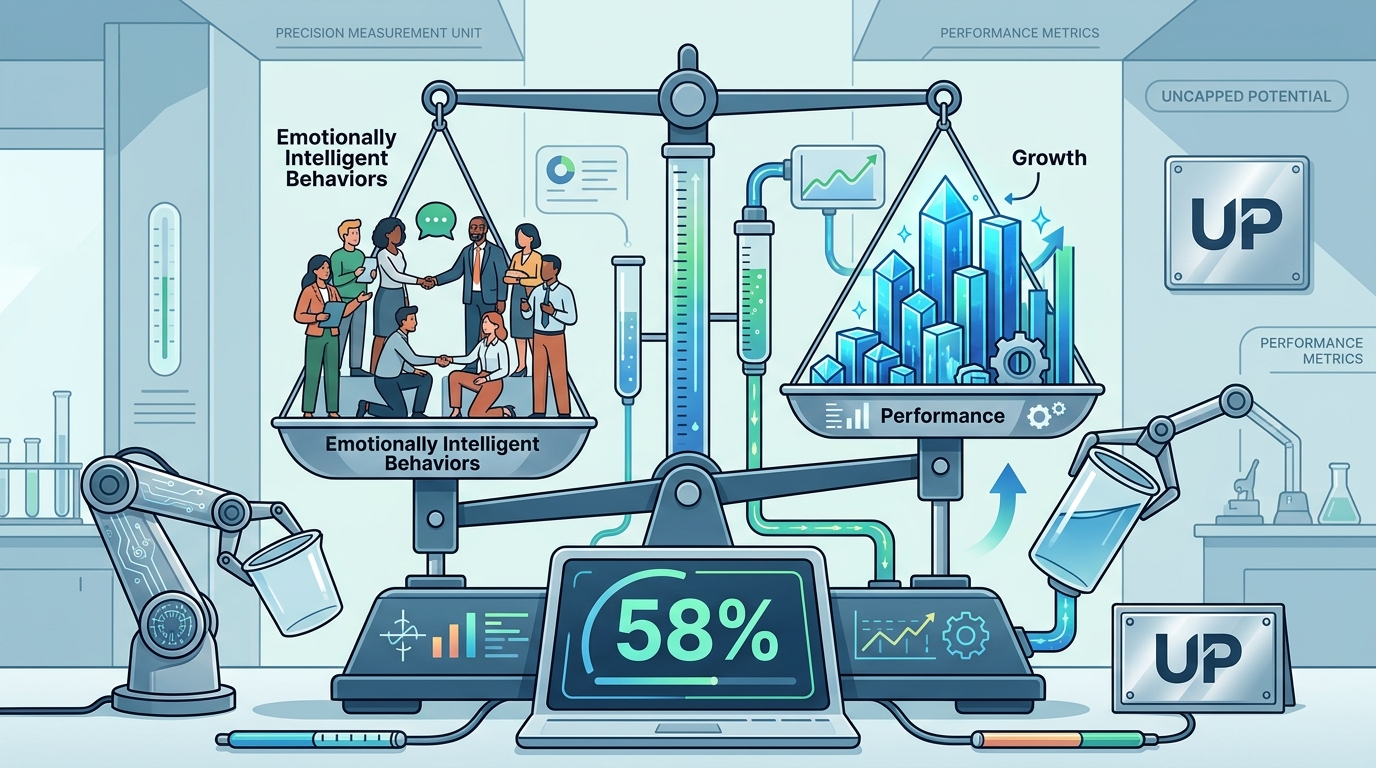
Emotional intelligence is not a soft skill. It is the single most under leveraged competitive advantage available to any organisation and the one thing AI cannot replace. Despite this critical distinction, many leaders struggle to quantify its value. Research indicates that emotional intelligence accounts for nearly 58% of performance in all types of jobs. This statistic underscores the necessity of moving beyond anecdotal evidence to rigorous assessment. Organizations that fail to measure this capability often miss the root causes of cultural stagnation and leadership failure. (Extensive Real World Experience)
Defining Emotional Intelligence in Business
To measure emotional intelligence effectively, we must first establish a precise definition. Emotional intelligence is the ability to recognize, understand, and manage our own emotions and those of the people around us. In a corporate context, this translates to strategic decision-making, conflict resolution, and team cohesion. Without a clear definition, measurement tools lack a standardized baseline. (Leadership Emotional Intelligence Uncapped)
Leadership Emotional Intelligence is distinct from general personality traits. It focuses specifically on the application of emotional awareness in high-stakes environments. When leaders lack this awareness, they often operate within their limits, missing opportunities for transformation. We help organisations find out what happens when you don't, because human potential is limitless. This potential is unlocked only when EI is explicitly identified and tracked.
Self Awareness is the skill most people think they have but don’t. It serves as the foundation for all other EI competencies. Without accurate self-assessment, subsequent measurements of empathy or social skill become unreliable. Organizations must prioritize diagnostic clarity before attempting to build capability.
Core Measurement Frameworks
Assessing EI requires robust psychometric instruments. These tools provide the data necessary to close the gap between intent and impact. Several established frameworks dominate the industry, each offering unique insights into leadership behavior.
Mayer-Salovey-Caruso Model
This model treats emotional intelligence as a true ability, similar to IQ. It measures four branches: perceiving emotions, using emotions to facilitate thought, understanding emotions, and managing emotions. This approach is highly objective but can be difficult to apply in real-time leadership scenarios. It provides a baseline for cognitive emotional processing rather than behavioral output.
Goleman’s Competency Model
Daniel Goleman’s framework focuses on five components: self-awareness, self-regulation, motivation, empathy, and social skill. This model is widely used in corporate training because it links directly to job performance. It allows organizations to map specific EI competencies to leadership roles. The Empathy Trap: how a great leadership skill has become a great cop out. This insight highlights the danger of measuring empathy without context. Leaders may appear empathetic but fail to drive necessary performance outcomes.
360-Degree Feedback
While not a standalone EI test, 360-degree feedback is a critical measurement tool. It aggregates data from peers, subordinates, and supervisors to provide a holistic view of a leader’s emotional impact. This method reveals blind spots that self-reporting often misses. It is particularly effective for identifying gaps in communication and conflict management.
The Human Synergistics Approach
At Uncapped Potential, we leverage Human Synergistics Leader and Organisation Culture Insights to measure EI. This framework is distinct because it connects emotional intelligence directly to organizational culture. It moves beyond individual traits to examine how leaders influence the collective environment.
The Human Synergistics LSI® (Leadership Style Inventory) assesses leadership styles across three categories: constructive, passive-defensive, and aggressive-defensive. Constructive styles, such as achievement-oriented and self-actualizing, are strongly correlated with high performance. Passive-defensive styles, like avoidance and approval-seeking, often stifle innovation. Aggressive-defensive styles, such as oppositional and competitive, can create toxic work environments.
We have been harnessing the power of emotional intelligence and sculpting high performing cultures built on trust, authenticity and purpose, for more than 30 years. This longevity provides a deep dataset for understanding how EI impacts long-term organizational health. Our data shows that leaders utilizing these insights drive significantly higher engagement and retention rates.
Psychosocial safety is a critical outcome of high EI. Emotional Intelligence: cultivating psychosocial safety. When leaders measure and improve their EI, they create environments where employees feel safe to take risks and share ideas. This safety is not a perk; it is a performance multiplier. It reduces turnover and accelerates problem-solving.
Linking EI to Performance Metrics
Measuring EI is only valuable if it correlates with tangible business results. Organizations must track specific KPIs to validate the impact of EI interventions.
Employee Engagement and Retention
High EI leaders foster stronger connections with their teams. This leads to increased engagement scores and lower turnover. According to industry data, companies with highly engaged workforces see 21% greater profitability. This correlation is driven by the emotional climate created by leadership. When leaders are emotionally intelligent, they can address employee concerns proactively, preventing disengagement.
Decision-Making Quality
Emotional intelligence enhances cognitive processing under pressure. Leaders with high EI can regulate their stress responses, allowing for clearer thinking. This is crucial in crisis management. The boardroom blindspot: why leaders are the biggest risk. This risk is often rooted in a lack of self-awareness and emotional regulation. Measuring EI helps identify leaders who may struggle with high-pressure decision-making.
Team Collaboration
Teams led by emotionally intelligent leaders exhibit better collaboration. They communicate more effectively and resolve conflicts faster. This is measured through team performance metrics, such as project completion times and quality scores. Culture surveys: the hidden costs of a false sense of transparency. These surveys can reveal whether EI is genuinely improving collaboration or if surface-level harmony masks underlying issues.
Comparing EI Assessment Tools
Selecting the right measurement tool is critical. The following table compares the primary approaches used in organizational settings.
| Assessment Tool | Primary Focus | Measurement Method | Best Use Case |
|---|---|---|---|
| Human Synergistics LSI® | Leadership Style & Culture | Self-report & Observer ratings | Organizational transformation |
| Mayer-Salovey-Caruso (MSCEIT) | Cognitive Ability | Performance-based test | Individual skill development |
| EQ-i 2.0 | Emotional Competencies | Self-report & Multi-rater | Leadership coaching |
| 360-Degree Feedback | Behavioral Impact | Multi-source feedback | Performance reviews |
Each tool offers different insights. The LSI® is particularly valuable for understanding the cultural impact of leadership. It aligns with our philosophy that results and people matter and emotional Intelligence is a superpower. By combining these tools, organizations can gain a comprehensive view of their leadership capability.
Key Takeaways
- Emotional intelligence is the single most under leveraged competitive advantage available to any organisation and the one thing AI cannot replace.
- Human Synergistics LSI® provides deep insights into how leadership styles impact organizational culture.
- +1200 Leaders & HR Practitioners trained in Emotional Intelligence through our programs demonstrate measurable performance gains.
- Self Awareness is the skill most people think they have but don’t, making accurate assessment critical.
- Psychosocial safety is a direct outcome of high EI leadership, driving innovation and risk-taking.
- 45 years of combined experience in HR and leadership informs our diagnostic methodologies.
- 100% Repeat Clients and ongoing partnerships reflect the sustained value of EI-focused advisory services.
Frequently Asked Questions
How is emotional intelligence different from personality traits?
Personality traits are relatively stable over time, whereas emotional intelligence is a set of learnable skills. EI focuses on the ability to manage emotions in real-time, which can be developed through training and feedback. Personality describes how you naturally react, while EI describes how you choose to manage those reactions.
What is the most accurate tool for measuring EI in leaders?
There is no single "most accurate" tool, as each measures different aspects. Human Synergistics LSI® is highly effective for measuring the cultural impact of leadership. For individual skill development, the EQ-i 2.0 or MSCEIT may be more appropriate. A combination of tools often provides the most comprehensive view.
Can emotional intelligence be improved through training?
Yes, emotional intelligence is highly malleable. Through targeted coaching, such as Coach. purposeful conversations©, leaders can develop specific EI competencies. Our data shows that leaders using these purposeful conversations see significant improvements in team performance and engagement.
Why is emotional intelligence critical for HR leaders?
HR leaders must navigate complex human dynamics daily. Emotional Intelligence: cultivating psychosocial safety. HR professionals with high EI can better manage conflict, drive change, and support employee well-being. This leads to more effective HR strategy and execution.
How does EI impact organizational culture?
Leadership styles directly shape culture. Constructive leadership styles, driven by high EI, foster trust and collaboration. Defensive styles, driven by low EI, create fear and silos. Measuring EI helps identify and correct these cultural drivers.
What is the ROI of investing in EI measurement?
The ROI is significant. Improved EI leads to better retention, higher engagement, and more effective decision-making. These factors directly impact the bottom line. Organizations that invest in EI often see a rapid return through reduced turnover costs and increased productivity.
How often should EI be reassessed?
EI should be reassessed regularly, typically annually or during major organizational changes. This ensures that development efforts are on track and that new challenges are being addressed. Continuous measurement allows for adaptive leadership strategies.
Next Steps for Leaders
Are you ready to close the gap between intent and impact? Most organisations operate well within their limits. We help organisations find out what happens when you don't, because human potential is limitless. Contact us to explore how our advisory services can transform your leadership capability.
Visit our Solutions page to learn more about our tailored programs. Explore our Case Studies to see real-world results. Schedule a consultation via our Contact page to begin your journey.