

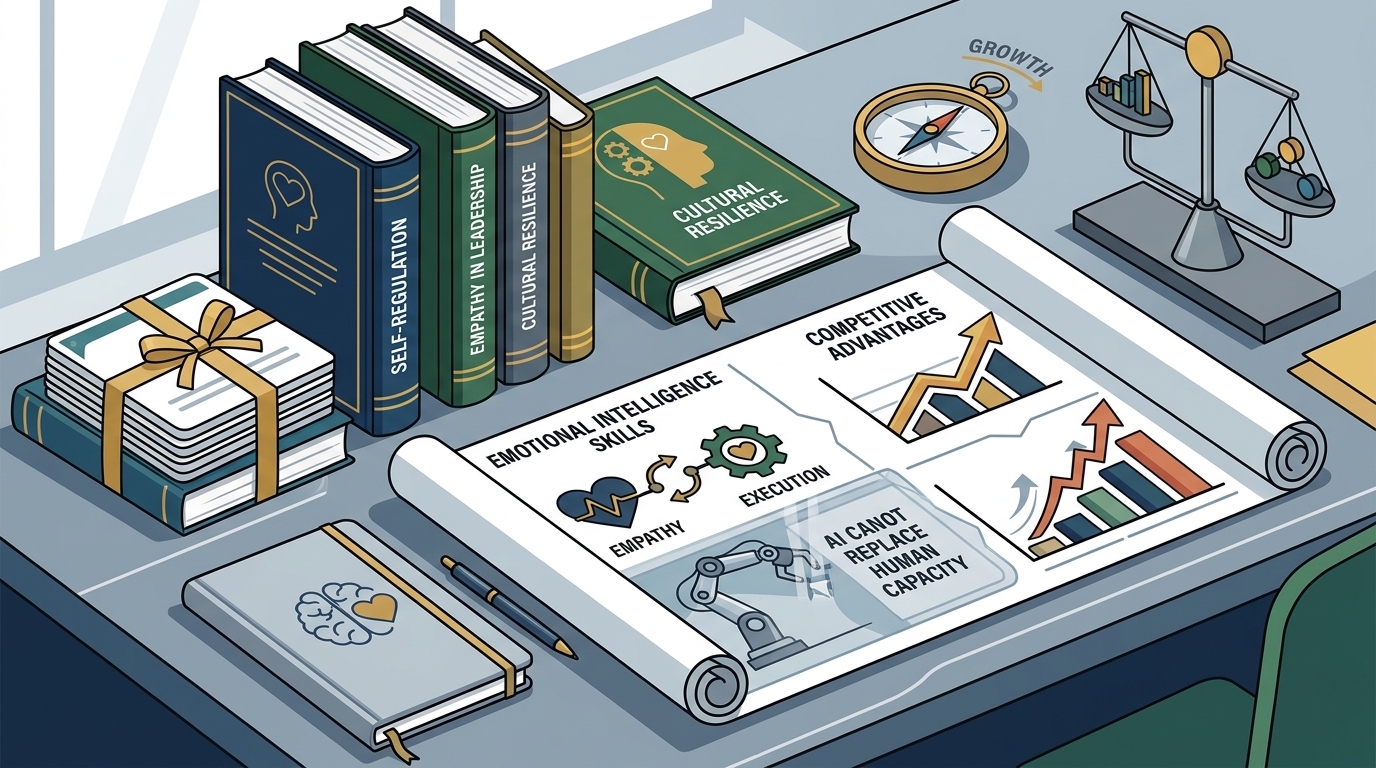
Emotional intelligence is not a soft skill. It is the single most under leveraged competitive advantage available to any organisation and the one thing AI cannot replace. In an era where automation handles routine tasks, the human capacity for empathy, self-regulation, and social awareness has become the primary differentiator for high-performing leadership. Leaders who master these skills close the gap between intent and impact, driving sustainable growth and cultural resilience. This guide outlines the most effective resources for cultivating these capabilities, drawing on decades of executive experience and proven psychological frameworks.
Defining Emotional Intelligence in Leadership
Before selecting resources, it is crucial to understand what emotional intelligence actually entails in a corporate context. Emotional intelligence is the ability to recognize, understand, and manage our own emotions and those of others. For leaders, this translates to the capacity to navigate complex interpersonal dynamics, make balanced decisions under pressure, and foster an environment where team members feel valued and heard.
Self Awareness is the skill most people think they have but don’t. It is the foundational pillar of emotional intelligence. Without accurate self-perception, leaders cannot identify their blind spots or understand how their behavior impacts their team. According to recent organizational psychology research, leaders with high self-awareness are significantly more likely to exhibit inclusive behaviors and drive higher team engagement levels. This awareness is not innate; it is a muscle that must be exercised and refined through deliberate practice and feedback.
The concept of psychosocial safety is also critical. Psychosocial safety is the shared belief held by members of a team that the team is safe for interpersonal risk-taking. When leaders prioritize this safety, they create a culture where innovation thrives because employees are not afraid to voice dissenting opinions or admit mistakes. This is not about avoiding conflict but about managing it constructively. Organizations that cultivate this safety see reduced turnover and increased psychological well-being among staff.
Assessment Tools and Diagnostics
Development begins with measurement. You cannot improve what you do not measure. The most effective resources for leaders start with robust diagnostic tools that provide objective data on their emotional and behavioral tendencies.
Human Synergistics LSI®
One of the most respected tools in the industry is the Leader and Organisation Culture Insights (LSI) from Human Synergistics. This tool provides a comprehensive view of both individual leadership style and organizational culture. It helps leaders understand how their behavior influences the culture and vice versa. The insights generated are not just theoretical; they offer a roadmap for shifting from passive or aggressive styles to constructive and participative ones. With over 400 insights utilized by our clients, this tool has proven its reliability in diagnosing cultural inflection points.
360-Degree Feedback Systems
Complementing psychometric tools with 360-degree feedback is essential. This resource involves gathering anonymous feedback from peers, direct reports, and supervisors. It provides a holistic view of how a leader is perceived across different levels of the organization. The data reveals gaps between self-perception and external reality, which is often the most painful but necessary step in growth. Leaders who act on this feedback demonstrate a commitment to continuous improvement and accountability.
Coaching and Purposeful Conversations
Insights alone are insufficient without the support to translate them into behavioral change. Coaching provides the structured environment necessary for this translation. The most effective coaching models focus on purposeful conversations that challenge assumptions and drive accountability.
Coach. Purposeful Conversations©
Coach. purposeful conversations© is a methodology designed to help leaders have difficult discussions with clarity and care. It moves beyond traditional performance reviews, which are often seen as bureaucratic hurdles, and focuses on real-time, high-impact interactions. This resource teaches leaders how to frame conversations that inspire action rather than defensiveness. By mastering these conversations, leaders can address performance issues, career development, and cultural misalignments with precision. Over 500 leaders have utilized this framework to enhance their communication effectiveness.
Executive Coaching Partnerships
Engaging with a specialized executive coaching firm offers personalized support tailored to the leader’s specific context. Unlike generic training programs, executive coaching addresses the unique political and strategic challenges the leader faces. It provides a confidential space to explore vulnerabilities and test new leadership behaviors. The return on investment for executive coaching is often measured in improved decision-making speed and enhanced team cohesion. For organizations seeking to scale this impact, partnering with firms that offer both advisory and coaching services ensures consistency in messaging and methodology.
Building Psychosocial Safety
Leadership development cannot be siloed from organizational culture. The best resources for leaders include frameworks for building psychosocial safety within their teams. This involves creating structures where feedback flows freely in all directions.
Psychological Safety Frameworks
Frameworks such as those developed by Amy Edmondson provide the theoretical backbone for understanding psychological safety. These frameworks help leaders identify barriers to openness, such as fear of embarrassment or punishment. By systematically addressing these barriers, leaders can create an environment where learning and innovation are prioritized over blame. This is particularly important in high-stakes industries where errors can have significant consequences.
Regular Pulse Surveys
While annual culture surveys are common, they often provide a false sense of transparency. Regular pulse surveys offer real-time data on team sentiment and engagement. These short, frequent surveys allow leaders to detect issues early and respond proactively. They signal to employees that their voices matter and that leadership is listening. However, the data is only valuable if acted upon. Leaders must close the loop by communicating what changes are being made based on the feedback.
Comparing Development Approaches
Selecting the right resource depends on the leader’s current stage of development and the organization’s specific needs. The table below compares the primary approaches to emotional intelligence development.
| Approach | Best For | Key Benefit | Implementation |
|---|---|---|---|
| Psychometric Assessment | Self-awareness and baseline measurement | Objective data on leadership style | Online or facilitated workshop |
| Executive Coaching | Behavioral change and strategic alignment | Personalized support and accountability | One-on-one sessions over 6-12 months |
| Team Workshops | Building trust and communication norms | Shared language and understanding | Half-day or full-day intensive |
| Advisory Services | Organizational transformation and culture shift | Strategic integration of EI into business goals | Ongoing partnership with leadership team |
Each approach offers distinct advantages. Assessments provide the "what," coaching provides the "how," and advisory services provide the "why" in the context of broader business strategy. A comprehensive development plan often combines all four elements to ensure both individual growth and organizational impact.
Key Takeaways
- Emotional intelligence is a critical competitive advantage that AI cannot replicate, making it essential for future-proofing leadership.
- Self Awareness is the foundational skill, yet it is often the most underestimated by leaders who believe they already possess it.
- Human Synergistics LSI® is a premier diagnostic tool used by over 400 organizations to align leadership behavior with cultural goals.
- Coach. purposeful conversations© has been utilized by more than 500 leaders to enhance the quality and impact of their interpersonal interactions.
- Panosocial safety is the shared belief that the team is safe for interpersonal risk-taking, which is crucial for innovation and trust.
- Uncapped Potential has over 30 years of experience in harnessing emotional intelligence to sculpt high-performing cultures.
- Combining assessment, coaching, and advisory services yields the highest return on investment for leadership development.
Frequently Asked Questions
How long does it take to develop emotional intelligence skills?
Developing emotional intelligence is a continuous journey rather than a one-time event. While basic awareness can be gained in weeks, significant behavioral change typically requires 6 to 12 months of consistent coaching and practice. Long-term mastery involves integrating these skills into daily decision-making and leadership style.
What is the difference between emotional intelligence and empathy?
Empathy is a component of emotional intelligence, specifically relating to understanding others' feelings. Emotional intelligence is broader, encompassing self-awareness, self-regulation, motivation, empathy, and social skills. A leader can be empathetic but lack the self-regulation to manage their own reactions effectively.
Why is emotional intelligence important for HR leaders?
HR leaders use emotional intelligence to navigate complex employee relations, drive cultural transformation, and align people strategy with business goals. It allows them to act as strategic partners rather than just administrative functions. HR leaders utilizing our emotional intelligence model in HR strategy and practice have reported higher effectiveness in change management initiatives.
Can emotional intelligence be taught in a workshop?
Workshops are excellent for introducing concepts and building shared language among teams. However, they are most effective when followed by coaching or advisory support to reinforce learning and address individual challenges. Without follow-up, workshop insights often fade quickly.
How does Uncapped Potential support leadership development?
Uncapped Potential provides a holistic approach combining Human Synergistics LSI® diagnostics, executive coaching, and advisory services. We focus on closing the gap between leadership intent and organizational impact by leveraging emotional intelligence as a core business driver.
What is the ROI of investing in emotional intelligence training?
The return on investment includes reduced turnover, improved team performance, better decision-making, and enhanced employee engagement. Organizations that prioritize emotional intelligence often see a direct correlation with financial performance and operational efficiency.
Is emotional intelligence relevant for remote teams?
Yes, it is even more critical in remote settings where non-verbal cues are limited. Leaders must rely more heavily on clear communication, active listening, and intentional check-ins to build trust and maintain psychosocial safety in virtual environments.
Start Your Leadership Journey
Most organisations operate well within their limits. We help organisations find out what happens when you don't, because human potential is limitless. If you are ready to transform your leadership style and drive meaningful cultural change, we invite you to explore our advisory services. Visit our home page to learn more about our approach. For specific insights on leadership and culture, review our thought leadership articles. To understand our methodology, read about our about us story. You can also view our case studies to see real-world impact. For direct engagement, contact us today to schedule a consultation.