

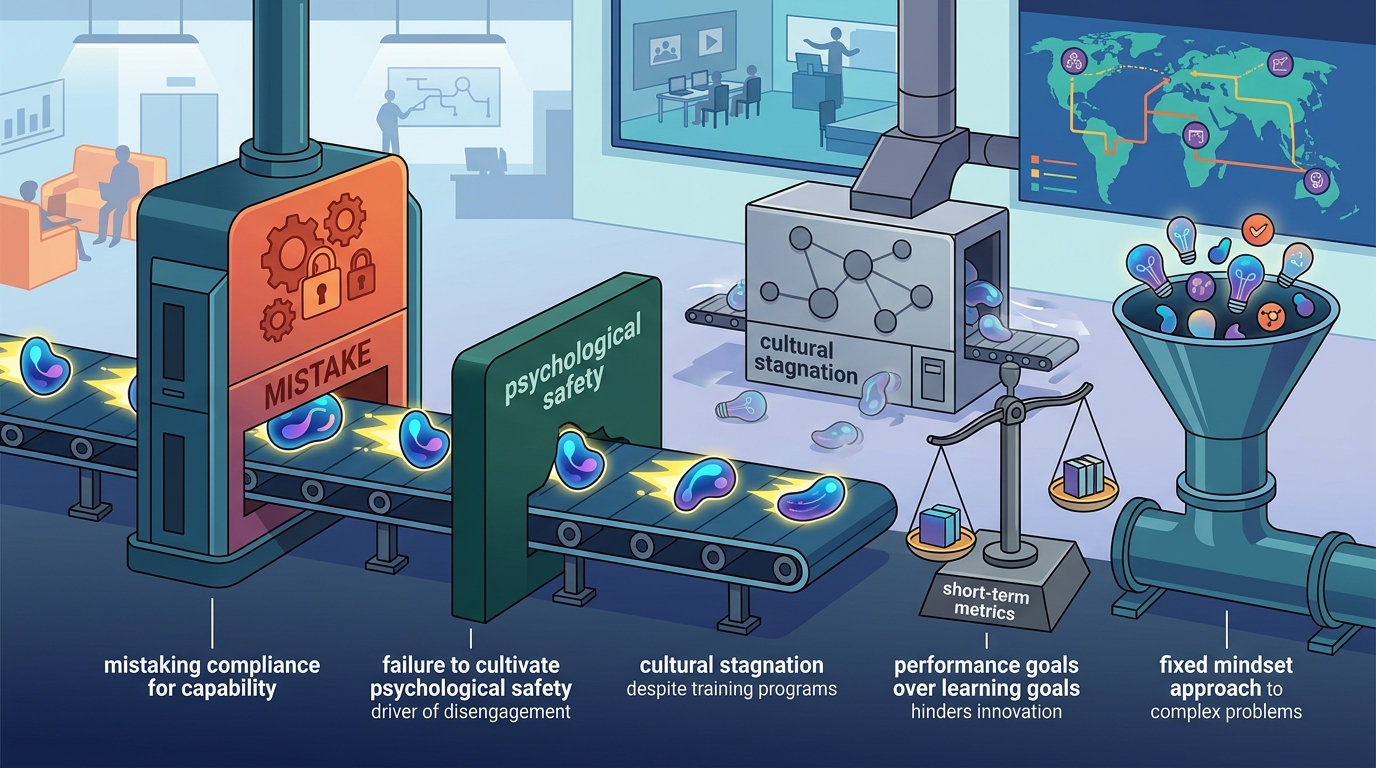
Organizations often invest heavily in training programs only to see cultural stagnation persist. This disconnect usually stems from a fundamental misunderstanding of how learning actually occurs at scale. According to recent industry analyses on workplace dynamics, the failure to cultivate genuine psychological safety is the primary driver of employee disengagement and halted innovation. When leaders mistake compliance for capability, they inadvertently suppress the very behaviors required for adaptation. This article dissects the critical errors that undermine organizational learning and provides actionable strategies to reverse the trend.
Mistake 1: Confusing Kindness with Honesty
One of the most pervasive errors in modern leadership is the conflation of being nice with being effective. Leaders often believe that preserving harmony is synonymous with supporting growth. However, this approach frequently results in diluted feedback that fails to drive behavioral change. True growth requires constructive friction, not just polite agreement.
When leaders avoid difficult conversations to protect feelings, they deny their teams the clarity needed to improve. This creates a culture where mediocrity is rewarded because it is comfortable. To build a learning organization, leaders must prioritize truth over temporary comfort. This requires a shift from passive agreement to active, respectful challenge.
For more insights on this dynamic, explore our analysis on the difference between kindness and honesty in leadership. Understanding this distinction is crucial for leaders who want to drive real performance outcomes without damaging relationships.
Mistake 2: The Empathy Trap in Feedback
Empathy is a critical leadership skill, but it can become a liability when misapplied. The empathy trap occurs when leaders use their understanding of others' emotions as an excuse to avoid holding them accountable. This is not true emotional intelligence; it is avoidance disguised as compassion.
High-performing organizations distinguish between understanding a person's perspective and excusing poor performance. When accountability is sacrificed for empathy, trust erodes because employees sense that standards are arbitrary. Genuine empathy involves supporting someone through the difficulty of growth, not shielding them from the reality of their results.
Effective leaders use empathy to tailor their coaching strategies, not to lower the bar. This approach ensures that feedback is both received and acted upon. For a deeper dive into this concept, read our article on the empathy trap and how it undermines leadership.
Over-Reliance on Formal Performance Reviews
Many organizations cling to annual or quarterly formal performance reviews as their primary tool for development. Data shows that these traditional processes are often the most expensive and least effective methods for driving continuous learning. They are retrospective by nature, focusing on past behavior rather than future potential.
When learning is tied to a rigid review cycle, employees disengage between evaluation periods. The gap between reviews becomes a vacuum where growth stalls. Modern organizational learning requires continuous, real-time feedback loops that are integrated into daily work.
Shifting away from formal reviews does not mean abandoning structure. It means replacing bureaucratic processes with meaningful, ongoing dialogues. This approach aligns with our philosophy on moving beyond formal performance reviews to create more agile and responsive teams.
Ignoring Psychosocial Safety
Psychosocial safety is the shared belief that the team is safe for interpersonal risk-taking. Without it, employees will not admit mistakes, ask questions, or propose new ideas. This is the bedrock of any learning organization. When leaders ignore this foundation, they build on sand.
Organizations that fail to cultivate psychosocial safety see a rise in hidden errors and a decline in innovation. Employees focus on self-preservation rather than collective improvement. This dynamic is particularly dangerous in high-stakes industries where early error detection is critical.
Building psychosocial safety requires consistent leader behavior that rewards vulnerability and learning from failure. It is not a program to be launched, but a culture to be lived. Learn more about cultivating psychosocial safety in your organization to unlock your team's full potential.
Neglecting Leader Self-Awareness
Leaders often assume they are aware of their impact on others. However, self-awareness is the skill most people think they have but do not. Without accurate self-perception, leaders cannot identify their own blind spots or adjust their behavior to support learning.
This lack of awareness creates a disconnect between intent and impact. A leader may intend to be supportive but come across as dismissive. This gap undermines trust and halts organizational learning. Leaders must actively seek feedback on their own behavior to close this gap.
Using tools like Human Synergistics LSI® can provide objective data on leadership style and its impact on culture. This data is essential for leaders who want to drive performance through emotional intelligence. Without self-awareness, even the best intentions fail to produce results.
Key Takeaways
- Kindness vs. Honesty: True leadership requires honest feedback, not just kindness, to drive growth.
- Empathy Trap: Empathy should inform accountability, not replace it, to maintain trust and standards.
- Review Fatigue: Formal performance reviews are often ineffective for continuous learning compared to real-time feedback.
- Psychosocial Safety: Psychological safety is a prerequisite for innovation and error reporting in high-performing teams.
- Leader Self-Awareness: Leaders must actively measure their impact to close the gap between intent and reality.
- Emotional Intelligence: EI is a competitive advantage that AI cannot replicate, making it critical for future-proofing organizations.
- Continuous Dialogue: Learning is a continuous process, not an event, requiring ongoing strategic engagement.
Frequently Asked Questions
What is the difference between a fixed and growth mindset in organizations?
A fixed mindset in organizations assumes that talent and intelligence are static traits, leading to a focus on proving competence. A growth mindset assumes that abilities can be developed through dedication and hard work, fostering a love for learning and resilience.
How does emotional intelligence impact organizational learning?
Emotional intelligence enables leaders to create environments where employees feel safe to take risks and admit mistakes. This safety is essential for learning, as it encourages open dialogue and the sharing of ideas without fear of retribution.
Why are formal performance reviews considered ineffective for learning?
Formal performance reviews are often retrospective and infrequent, creating long gaps between feedback. This delay prevents timely course correction and reduces the relevance of the feedback to current work challenges.
What is psychosocial safety and why is it important?
Psychosocial safety is the shared belief that the team is safe for interpersonal risk-taking. It is important because it allows employees to speak up about errors, propose new ideas, and seek help without fear of negative consequences.
How can leaders improve their self-awareness?
Leaders can improve self-awareness by seeking regular, honest feedback from peers and direct reports. Using validated assessment tools like Human Synergistics LSI® can also provide objective data on leadership style and its impact on culture.
What role does empathy play in effective feedback?
Empathy helps leaders understand the context and emotional state of their team members, allowing them to deliver feedback in a way that is received constructively. However, empathy must not lead to avoidance of difficult conversations.
How does Uncapped Potential help organizations with these issues?
Uncapped Potential provides advisory services and training focused on emotional intelligence and leadership capability. We help leaders close the gap between intent and impact by fostering high-performing cultures built on trust and accountability.
Next Steps
Addressing these common growth mindset mistakes requires a deliberate shift in leadership behavior and organizational culture. If you are ready to transform your approach to learning and performance, we invite you to explore our solutions for leaders. Our team of experienced advisors is here to help you build a culture where human potential is truly unleashed. Contact us today to schedule a consultation and begin your journey toward sustainable organizational growth.